
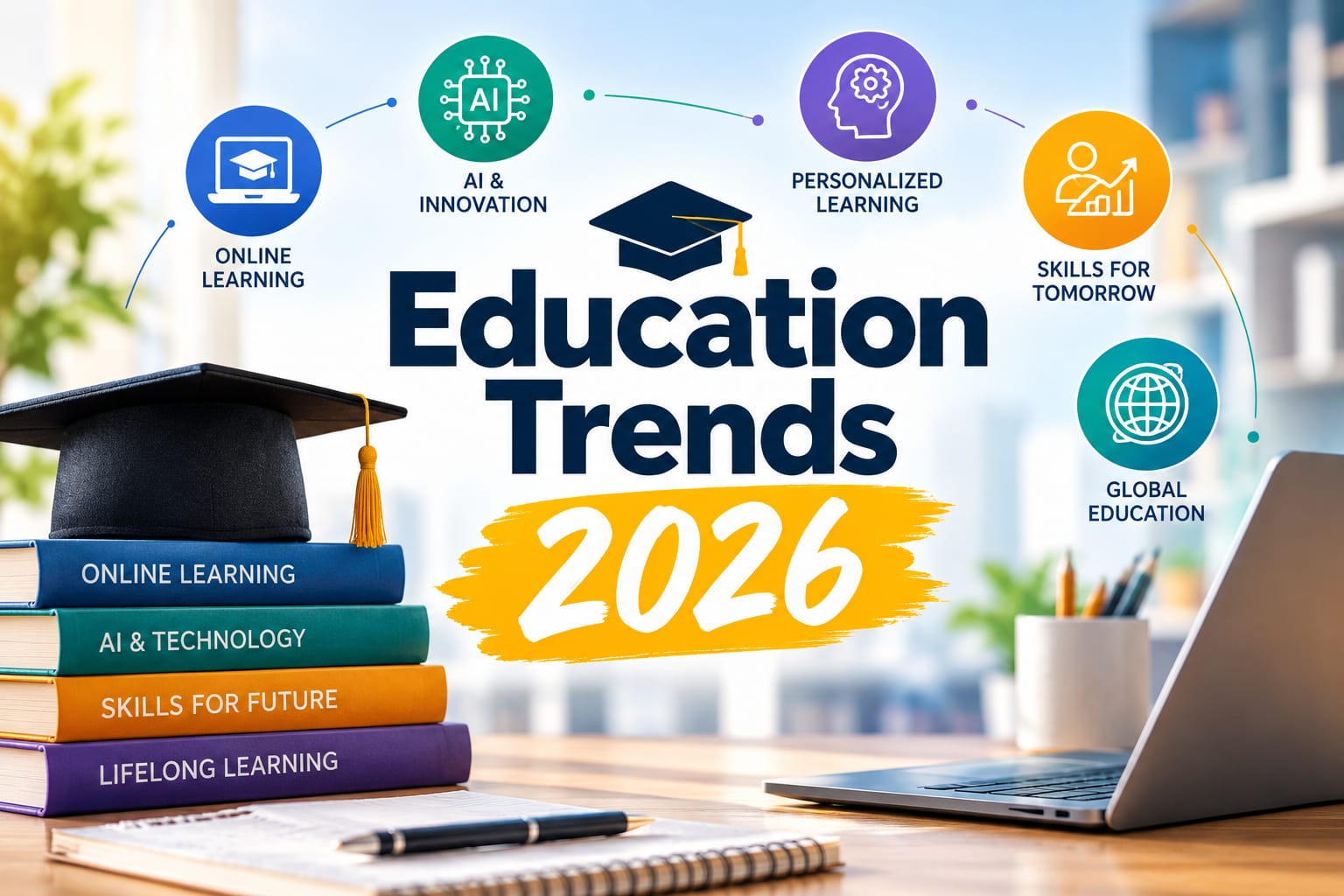
Education Trends 2026
Education Trends 2026: How Learning Is Being Reshaped
Education is going through one of the fastest transformations in its history. Between artificial intelligence, changing job markets, and new expectations from students and parents alike, 2026 is shaping up to be a pivotal year for how the world learns, teaches, and certifies knowledge. Whether you’re an educator, an ed-tech entrepreneur, or simply someone planning your next career move, understanding the education trends 2026 landscape can help you stay ahead of the curve.
Below is a professional, in-depth look at education trends 2026 — the shifts defining how schools, universities, and online platforms are evolving this year — followed by answers to the most commonly asked questions about education trends 2026.
1. AI-Powered Personalized Learning: A Leading Education Trend in 2026
Artificial intelligence has moved from a buzzword to a core part of classroom infrastructure. According to UNESCO’s guidance on AI in education, institutions worldwide are being encouraged to adopt AI responsibly while keeping human oversight central to teaching. In 2026, AI tutors and adaptive learning platforms are being used to identify a student’s strengths, weaknesses, and pace in real time, then adjust content accordingly. Instead of a one-size-fits-all curriculum, students receive lesson plans tailored to how they actually learn — a shift that is proving especially valuable for students with learning differences or those who fall behind in traditional classroom settings.
Teachers are also benefiting: AI tools now handle grading, lesson planning, and administrative tasks, freeing up educators to focus on mentorship and one-on-one support. Among all education trends 2026 has introduced, this shift toward AI-assisted teaching is arguably having the deepest day-to-day impact on classrooms.
2. Skills-Based Education: One of the Top Education Trends 2026
Employers are increasingly prioritizing demonstrated skills over traditional degrees. Reports from the World Economic Forum’s Future of Jobs research highlight how fast-changing skill requirements are pushing both employers and learners toward continuous, modular education. This has fueled explosive growth in micro-credentials, nanodegrees, and stackable certificates that let learners build a qualification piece by piece. Universities and online platforms alike are partnering with companies to design curricula that map directly to real job requirements, making education more outcome-driven than ever before.
This trend ties closely to the broader shift toward lifelong learning — the idea that education doesn’t stop after graduation but continues throughout a person’s career as industries evolve. It’s one of the clearest examples of how education trends 2026 are being shaped directly by employer demand.
3. Hybrid and Flexible Learning: A Defining Education Trend of 2026
The pandemic-era experiment with remote learning has matured into permanent hybrid models. In 2026, most institutions offer a blend of in-person and online instruction, giving students flexibility without sacrificing the community and mentorship benefits of physical classrooms. The OECD’s work on the future of education notes that flexible delivery models are becoming a permanent fixture of national education strategies rather than a temporary pandemic-era fix. Asynchronous coursework, recorded lectures, and flexible deadlines are now standard features rather than emergency accommodations — a clear sign of how deeply education trends 2026 have normalized flexible delivery.
4. Immersive Technology (VR/AR): Shaping Education Trends 2026
Virtual and augmented reality are no longer experimental — they’re being used for everything from virtual science labs to historical simulations and medical training. Immersive technology allows students to “experience” complex concepts rather than just read about them, improving retention and engagement, particularly in STEM fields. This is one of the more visually striking education trends 2026 has brought into mainstream classrooms.
5. Mental Health and Wellbeing: A Human-Centered Education Trend in 2026
Educational institutions are placing greater emphasis on student wellbeing as part of the core curriculum, not an afterthought. Schools are integrating mindfulness programs, mental health resources, and social-emotional learning (SEL) into daily schedules, recognizing that academic performance is closely tied to emotional and psychological health, a link well documented by the World Health Organization’s work on adolescent mental health.
6. Gamification: An Engagement-Driven Education Trend for 2026
Game mechanics — points, badges, leaderboards, and interactive challenges — are being woven into curricula to boost motivation and engagement. This approach is particularly effective with younger learners and in subjects that traditionally struggle to hold attention, such as math and language learning — making gamification a consistently popular pick among education trends 2026 lists.
7. Sustainability and Climate Education: A Growing Education Trend in 2026
As climate concerns become more urgent globally, schools are embedding sustainability topics across subjects rather than treating them as a standalone unit. From environmental science to economics and civics, students are being equipped with the knowledge to understand and address climate-related challenges, reflecting how education trends 2026 increasingly connect classroom learning to global issues.
8. Global and Collaborative Classrooms: An Emerging Education Trend in 2026
Technology has made it easier than ever for classrooms to connect across borders. Virtual exchange programs, collaborative international projects, and multilingual learning tools are helping students develop global awareness and cross-cultural communication skills — qualities increasingly valued by employers in a connected, digital-first economy. This global outlook rounds out our list of education trends 2026.
Why These Education Trends 2026 Matter
Together, these shifts point to a broader transformation: education in 2026 is becoming more personalized, more flexible, more skills-focused, and more connected to real-world outcomes. Institutions and platforms that embrace these changes are better positioned to serve a generation of learners who expect technology, flexibility, and relevance from their education.
Further Reading
For deeper, data-backed insight into the trends covered above, these external resources are worth exploring:
- UNESCO – Artificial Intelligence in Education
- World Economic Forum – Future of Jobs Report
- OECD – Future of Education and Skills 2030
- World Health Organization – Adolescent Mental Health
- EDUCAUSE – Higher Education Technology Trends
Frequently Asked Questions About Education Trends 2026
Q1: What is the biggest education trend in 2026? AI-powered personalized learning is widely considered the biggest trend, as it’s reshaping how content is delivered, assessed, and adapted to individual students.
Q2: Are traditional degrees becoming less important? Not entirely, but their dominance is decreasing. Employers are placing more weight on demonstrated skills, micro-credentials, and practical experience alongside — or sometimes instead of — traditional degrees.
Q3: How is AI being used in classrooms in 2026? AI is used for personalized lesson plans, automated grading, intelligent tutoring systems, and administrative support, allowing teachers to focus more on mentorship and student engagement.
Q4: What role does VR/AR play in modern education? Virtual and augmented reality provide immersive learning experiences — such as virtual labs and simulations — that improve engagement and understanding, particularly in STEM subjects.
Q5: Why is mental health being prioritized in education? Research consistently shows a strong link between emotional wellbeing and academic performance, prompting schools to integrate mental health support directly into their programs rather than treating it separately.
Q6: Is hybrid learning here to stay? Yes. Hybrid learning has proven effective in offering flexibility while maintaining the benefits of in-person instruction, and most institutions now treat it as a permanent model rather than a temporary solution.
Q7: How can educators keep up with these trends? Continuous professional development, staying updated with ed-tech tools, and adopting a flexible, student-centered teaching approach are key strategies for educators to keep pace with these changes.


Add comment