
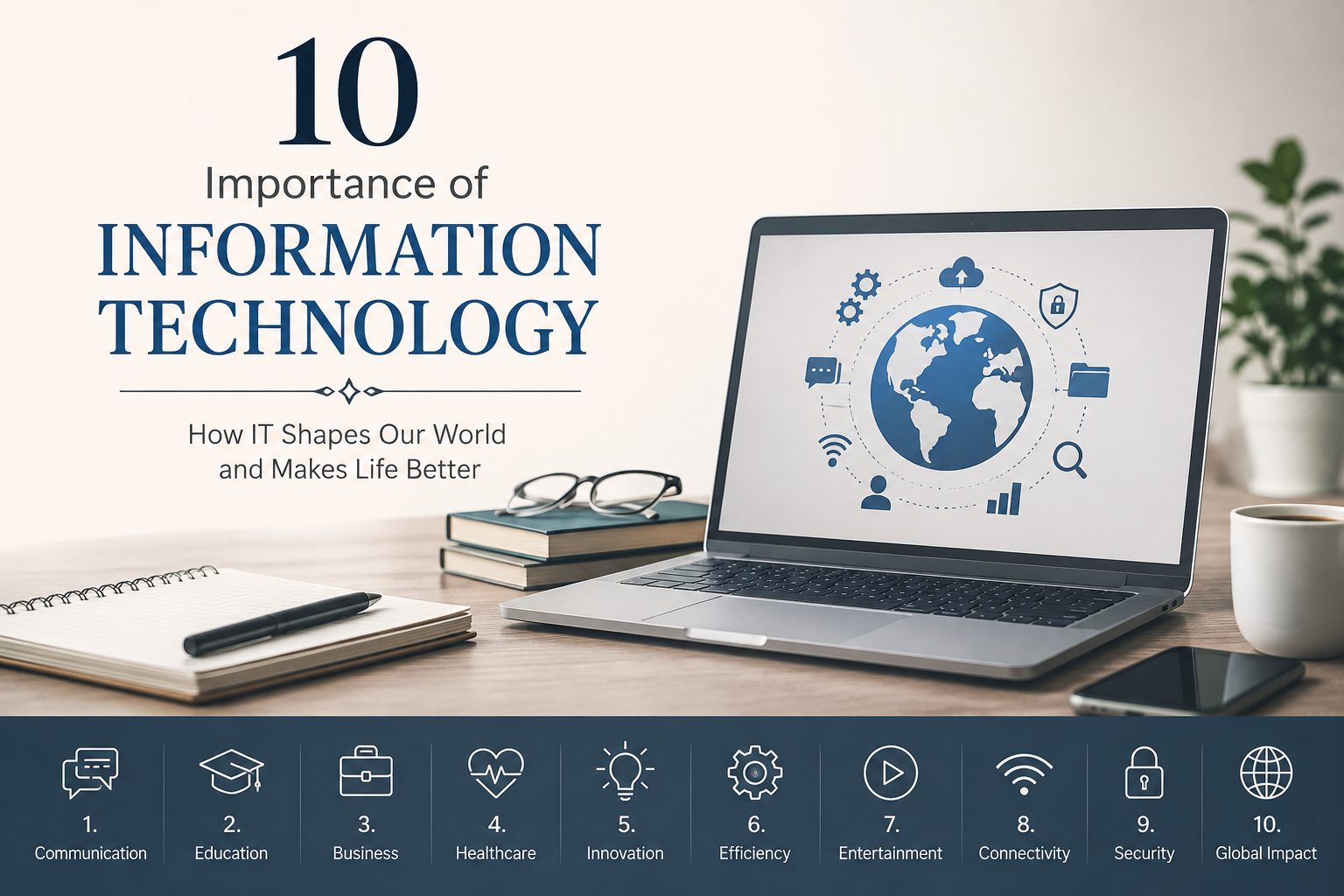
10 Importance of information technology
10 Importance of Information Technology
Information Technology (IT) has quietly become the backbone of almost everything we do — from how businesses operate to how we communicate with family across the world. Understanding the 10 Importance of Information Technology is no longer optional for professionals, students, or business owners; it’s essential for staying relevant in a fast-moving digital economy. In this article, we’ll walk through the 10 Importance of Information Technology that matter most today, and answer some of the most common questions people have about it.
Key Takeaways: The 10 Importance of Information Technology
- Information Technology improves efficiency, communication, and decision-making across every industry.
- Businesses that adopt IT effectively gain a real competitive advantage.
- IT has transformed education, healthcare, and everyday personal life.
- Recognizing the 10 Importance of Information Technology can help you make smarter technology decisions at work and at home.
The 10 Importance of Information Technology
Let’s break down the 10 Importance of Information Technology that matter most today, one at a time.
1. Faster and More Efficient Communication
One of the clearest examples of the 10 Importance of Information Technology is how it has transformed communication. Email, instant messaging, video calls, and collaboration tools have made it possible to connect with anyone, anywhere, in seconds. According to the International Telecommunication Union, the UN agency for digital technologies, global connectivity infrastructure continues to expand rapidly, bringing more people online every year. Businesses can now coordinate with international teams and clients without the delays that once came with traditional mail or long-distance calls — a shift also reflected in our earlier post on top technology trends right now.
2. Improved Business Efficiency and Productivity
IT systems automate repetitive tasks, streamline workflows, and reduce human error. From accounting software to inventory management systems, technology allows businesses to do more with fewer resources. McKinsey’s research shows that companies pursuing structured digital transformation consistently outperform peers on efficiency and value creation. This increase in productivity highlights the 10 Importance of Information Technology in helping companies of every size remain competitive.
3. Better Data Management and Storage
Before digital systems, businesses relied on paper files and physical storage — slow, space-consuming, and easy to lose. This is one of the more practical sides of the 10 Importance of Information Technology: it has made it possible to store, organize, and retrieve massive amounts of data instantly through databases and cloud storage. This is especially valuable for record-keeping, compliance, and long-term business planning.
4. Enhanced Decision-Making Through Data Analysis
Modern IT tools don’t just store data — they help make sense of it. As part of the 10 Importance of Information Technology, data analytics and business intelligence software allow organizations to identify trends, forecast demand, and make informed decisions rather than relying on guesswork. This is a major reason data-driven companies consistently outperform their competitors.
5. Growth of E-Commerce and Global Markets
Information Technology has removed geographic barriers to trade. Small businesses in Pakistan can now sell products to customers around the world through e-commerce platforms, digital payments, and online marketing. The World Bank has highlighted growing investment in Pakistan’s digital economy as a key driver of this shift. This global reach was simply not possible before the internet and modern IT systems.
6. Transformation of Education
IT has reshaped how students learn, with online courses, digital libraries, and virtual classrooms making education more accessible than ever. UNESCO has long promoted the innovative use of ICT to improve inclusion and equity in education worldwide. Students no longer need to be physically present in a specific location to access quality learning materials, and teachers can use technology to personalize instruction based on individual student needs.
7. Advancements in Healthcare
From electronic health records to telemedicine and AI-assisted diagnostics, IT has significantly improved how healthcare is delivered. The World Health Organization has noted the growing global use of digital tools to support diagnosis and health system management. Patients in remote areas can now consult with specialists without traveling long distances, and doctors can access complete patient histories instantly, leading to faster and more accurate treatment.
8. Stronger Cybersecurity and Data Protection
As more of our lives move online, protecting sensitive information has become critical. IT professionals and systems work to safeguard personal, financial, and business data from cyber threats through firewalls, encryption, and monitoring tools. Resources like NIST’s small business cybersecurity guidance help organizations of all sizes build this kind of protection. This protection is essential for maintaining trust in digital systems.
9. Increased Innovation and New Job Opportunities
The IT industry itself has created millions of jobs worldwide — from software development to cybersecurity to IT support. The World Economic Forum’s Future of Jobs Report projects tens of millions of new roles emerging from technology-driven change over the coming years. This is another clear sign of the 10 Importance of Information Technology: it drives innovation in nearly every other sector, leading to new products, services, and business models that didn’t exist a decade ago.
10. Convenience in Everyday Life
Perhaps the most personal item on this list of the 10 Importance of Information Technology is how it simplifies daily life. Online banking, food delivery apps, ride-hailing services, smart home devices, and entertainment streaming are all powered by IT systems working behind the scenes, making everyday tasks faster and more convenient than ever before. Even something as simple as a smart watch puts real-time health tracking, notifications, and payments right on your wrist — a small but powerful example of IT in daily life.
Conclusion: The 10 Importance of Information Technology
The 10 Importance of Information Technology covered above touch nearly every part of modern life — from how businesses compete, to how students learn, to how patients receive care, to how we stay connected with the people we care about. As technology continues to evolve, individuals and organizations that understand and embrace IT will be better positioned to grow, adapt, and thrive in an increasingly digital world.
For more insights on how technology is shaping everyday life, visit the Watch Wala blog, or explore watchwala.pk to see IT in action through smart, connected wearables.
FAQs About the 10 Importance of Information Technology
1. What is Information Technology (IT)? Information Technology refers to the use of computers, software, networks, and systems to store, process, retrieve, and exchange data. It covers everything from hardware and software to the internet and cybersecurity.
2. Why is Information Technology important for businesses? IT helps businesses improve efficiency, reduce costs, manage data more effectively, make better decisions, and reach customers globally through digital platforms — giving them a significant competitive advantage.
3. How has IT changed education? IT has made education more accessible through online courses, digital textbooks, virtual classrooms, and learning management systems, allowing students to learn at their own pace from almost anywhere.
4. What role does IT play in healthcare? IT supports healthcare through electronic health records, telemedicine, AI-assisted diagnostics, and remote patient monitoring, making medical care faster, more accurate, and more accessible.
5. Is Information Technology only relevant to large companies? No. Small businesses benefit just as much, if not more, from IT — using tools like e-commerce platforms, cloud accounting, and digital marketing to compete with much larger companies.
6. What career opportunities exist in Information Technology? IT offers a wide range of careers, including software development, network administration, cybersecurity, data analysis, cloud computing, and IT support — many of which are in high demand worldwide.
7. How does IT impact everyday personal life? IT simplifies daily tasks through online banking, mobile apps, smart home devices, streaming services, and instant communication tools, making everyday life more convenient and connected.




Add comment