
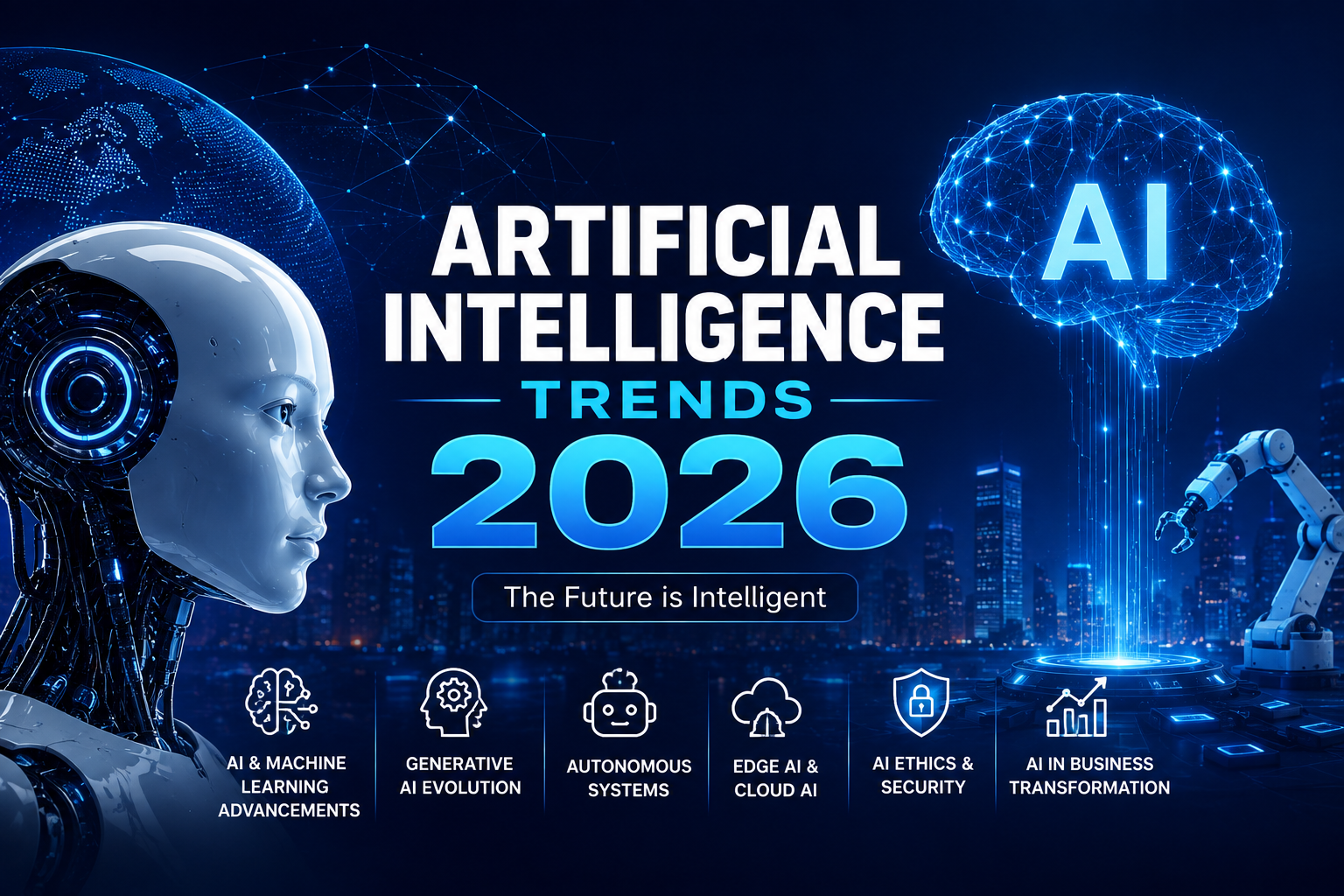
Artificial Intelligence Trends 2026
Artificial Intelligence Trends 2026
Artificial intelligence has moved past the experimentation phase. Where 2024 and 2025 were about proving that AI could work, 2026 is about proving that it delivers real, measurable results. Whether you are a business owner in Lahore, a developer in Karachi, or simply someone trying to understand where technology is heading, the Artificial Intelligence Trends 2026 are reshaping how we work, build, and make decisions. If you’re curious how these shifts connect to everyday tech, our earlier piece on top technology trends right now is a good companion read. This article breaks down the trends that matter most this year, and what you can do to stay ahead of them.
Key Takeaways
- Agentic AI is shifting from hype to real, supervised deployment inside businesses.
- AI governance is becoming a competitive advantage, not just a compliance requirement.
- Physical AI, including robots, is moving out of research labs and into daily operations.
- Healthcare is seeing some of the most impactful, real-world uses of AI in 2026.
- AI infrastructure is consolidating into leaner, more efficient “superfactories.”
- Understanding these Artificial Intelligence Trends 2026 can help you make smarter career and business decisions.
From Experiments to Impact: The Big Shift in 2026
For the past two years, most companies treated AI as a series of pilot projects. That phase is over. One of the clearest Artificial Intelligence Trends 2026 is the shift from proof-of-concept to proof-of-impact — organizations are now expected to show a real return on their AI investments, not just an interesting demo.
This means businesses are investing more in solid data foundations, clear metrics, and what some researchers call “human-AI chemistry” — the ability of teams and AI systems to work together effectively rather than AI simply replacing tasks. If you are evaluating AI tools for your business this year, the question is no longer “can it do something impressive?” but “does it measurably improve our outcomes?”
Agentic AI: From Chatbots to Digital Coworkers
Agentic AI is arguably the headline story among the Artificial Intelligence Trends 2026. Unlike earlier chatbots that simply answered questions, AI agents can now plan multi-step tasks, use tools, and carry out work with limited supervision — things like managing a calendar, researching a topic across multiple sources, or handling parts of a customer support workflow.
However, this trend comes with an important caveat: agentic AI works best where the underlying data and processes are already solid. Companies that try to bolt AI agents onto messy, disorganized systems tend to see disappointing results. The organizations getting real value are the ones that first cleaned up their data and workflows, then layered agents on top.
You can expect AI agents to increasingly act as digital coworkers in 2026 — handling repetitive research, content generation, and data-crunching tasks, while people focus on strategy, judgment, and creative direction. Microsoft’s own research describes this shift as AI “amplifying” people rather than replacing them, enabling small teams to punch above their weight.
AI Governance Becomes a Competitive Advantage
As AI systems take on more autonomous tasks, governance and oversight have become central to the Artificial Intelligence Trends 2026. It is no longer enough to deploy an AI tool and hope for the best. Enterprises are now developing clear internal principles for how AI should be used, monitored, and held accountable.
This shift is not just about avoiding risk. Organizations with clear AI governance are increasingly seen as more trustworthy by customers, regulators, and partners — turning what used to be a compliance checkbox into a genuine competitive edge. For businesses in Pakistan exploring AI adoption, building basic governance practices early — like human review of AI-generated decisions and clear data handling policies — will make scaling much easier later. Researchers at MIT Sloan Management Review point out that ongoing questions around who should manage data and AI remain one of the defining challenges of this year.
Physical AI and the Rise of Workplace Robots
Another major theme among the Artificial Intelligence Trends 2026 is the move of AI out of the screen and into the physical world. Humanoid robots and other forms of “physical AI” are transitioning from research demonstrations into real deployments — automating tasks in warehouses, manufacturing floors, and logistics operations.
This trend is closely tied to advances in “world models,” AI systems that understand and predict how physical environments behave, not just how language or images work. Industry analysis notes that CES 2026 featured a wave of humanoid robot demos across many companies, signaling how quickly this space is maturing. This same intelligence is already trickling down into everyday wearables — if you want to see it firsthand, browse our smart watch collection built around AI-powered health and fitness tracking. As these systems mature, expect to see more automation in physically demanding, repetitive jobs, while human oversight remains essential for safety and quality control.
AI in Healthcare: From Pilot Projects to Patient Care
Healthcare continues to be one of the most impactful areas among the Artificial Intelligence Trends 2026. AI is moving beyond experimental diagnostic tools into real, patient-facing applications at scale — supporting everything from earlier disease detection to personalized treatment planning. According to FPT Software’s research, healthcare AI is expanding well past diagnostic support toward broader, real-world clinical use.
For a country like Pakistan, where access to specialists is often limited outside major cities, AI-supported diagnostics and remote monitoring tools could meaningfully expand access to quality healthcare in 2026 and beyond, particularly in underserved and rural areas.
Smarter, Leaner AI Infrastructure
Running large AI models is expensive and energy-intensive, and one of the more technical Artificial Intelligence Trends 2026 addresses exactly that problem. Instead of scattered, underutilized servers, organizations are consolidating into what some call “AI superfactories” — globally interconnected, high-performance computing systems that intelligently distribute workloads to the most efficient resources available. Capgemini’s research describes this shift as AI becoming the backbone of enterprise architecture rather than a collection of isolated experiments.
At the same time, there’s a parallel push toward smaller, more efficient AI models deployed closer to where data is actually generated. This reduces latency, cuts costs, and gives organizations more control over sensitive data — an increasingly important consideration as AI regulations tighten around the world.
Geopolitics of Compute
Access to powerful computing hardware has become a matter of national strategy, and this is one of the more consequential Artificial Intelligence Trends 2026 to watch. Countries and companies are competing for access to advanced chips, data centers, and energy resources needed to train and run large AI models. The AI Trends Report 2026 by statworx identifies the “geopolitics of compute” as a defining trend, noting that processing power is increasingly becoming a question of global power.
For emerging markets, this trend underscores the importance of building local AI capacity — whether through partnerships, cloud access, or homegrown talent — rather than relying entirely on infrastructure controlled elsewhere. This is one more reason the Artificial Intelligence Trends 2026 deserve close attention from policymakers in developing economies, not just from Silicon Valley boardrooms.
What This Means for You in Pakistan
Understanding the Artificial Intelligence Trends 2026 is not just an academic exercise — it has real implications for your career and business:
- Professionals: Skills in prompt engineering, AI oversight, and data literacy are becoming as valuable as traditional technical skills.
- Small businesses: Even lightweight AI tools for customer service, content creation, or scheduling can free up significant time without a large upfront investment.
- Students: Understanding how AI agents and governance work will be increasingly relevant across almost every career path, not just computer science.
Conclusion
The Artificial Intelligence Trends 2026 make one thing clear: AI is no longer an experiment happening on the sidelines of business — it is becoming the backbone of how organizations operate, make decisions, and compete. From agentic AI and physical robots to healthcare breakthroughs and smarter infrastructure, this year marks a shift from AI as a novelty to AI as genuine, accountable infrastructure.
Whether you’re leading a business, building a career, or simply trying to stay informed, now is the time to understand these shifts and think about how they apply to your own work. The organizations and individuals who engage thoughtfully with these trends — rather than chasing hype — will be the ones best positioned for what comes next.
For more tech insights like this, visit the Watch Wala blog, or head to watchwala.pk to explore how AI-driven innovation is shaping the next generation of smart wearables.




Add comment